

As an integrated upstream-to-downstream nickel mining company, Harita Nickel believes that responsible mining includes how the company manages process residues & waste in accordance with applicable regulations.
Beyond regulatory compliance, the company continually strives to elevate management standards toward global best practices. This effort is driven by benchmarking against industry leaders and by audits against various national and international standards.
As part of this effort, Harita Nickel proactively committed to independent assessments from international bodies, including RMI-RMAP, IRMA, IFC Performance Standards, and ISO-related audits, as part of its overarching sustainability journey.
In managing by-products, the Company adopts circular economy principles, prioritizing resource efficiency and environmental protection as integrated objectives. This approach reflects our transition from a linear "take-make-dispose" model to a sustainable system that reduces waste generation, optimizes resource reuse, and minimizes environmental footprints.
In all operational areas, by-products from nickel processing—both RKEF smelters and HPAL refineries—is managed responsibly through land-based placement (with zero deep-sea tailings placement). Our usage of mined-out pits as placement facilities is a solution that is both secure and supportive of sustainable land management.
Every step is designed with rigorous safety standards, guided by strong governance principles:
· Expert Oversight: Design and reviews are conducted by independent experts in alignment with national and global safety standards, specifically SNI, GB, GISTM, ICOLD, and ANCOLD (2019).
· Empirical Validation: Material testing is performed by independent, accredited laboratories to confirm fill characteristics, support monitoring, and ensure accurate risk assessments.
· Systemic Analysis: We utilize comprehensive modeling and risk assessments, including dedicated hydrological and hydrogeological studies.
· Active Monitoring: Daily routine inspections and continuous stability monitoring of all stacks.
· Periodic Reviews: Facility management performance is reviewed weekly, monthly, and annually, with risk classifications updated accordingly.
· Crisis Readiness: Development of emergency response and contingency plans, including proactive socialization with employees and local communities.
· Technical Compliance: Execution of technical assessments and supporting procedures tailored to the specific type of facility in use.
This approach is reinforced by implementing mineral processing and refining industry best practices, conducting site-specific risk assessments for each operational location, and engaging in continuous learning through internal evaluations and benchmarking against similar facilities. Thus, by-product management is carried out safely, in a controlled manner, and responsibly, in line with the Company’s commitment to sustainability.
The Company is committed to managing all by-prodcuts safely, responsibly, and sustainably, in line with Environmental, Social, and Governance (ESG) principles. In its implementation, the company is committed to conducting periodic management reviews of its operational activities as part of continuous improvement efforts to enhance management performance, making it more effective and adaptive to various challenges.
Adaptive Operational Management Systems
1. Nickel Slag Management
Nickel slag is a byproduct of the Rotary Kiln Electric Furnace (RKEF) process, managed in line with the company’s circular economy commitment. This material is repurposed into various building materials, including bricks, road foundations, and artificial reefs, contributing to waste reduction and resource optimization.
In 2024, a total of 256,416 tons of nickel slag were successfully recycled, representing the company’s concrete effort to reduce industrial waste volume. Additionally, various trials continue to explore its potential to enhance vegetation, creating opportunities for broader environmental benefits.
Meanwhile, the remaining nickel slag is managed responsibly as backfill material for mined-out pits, contributing to land rehabilitation and the reduction of potential environmental impacts. Nickel slag is stored safely in designated facilities in compliance with all applicable regulations.
2. Tailing Management
The management of by-products from the HPAL (High Pressure Acid Leach) process is conducted through tailing placement in backfilling facilities within mined-out areas. The method used—a combination of dry and wet tailing—is based on comprehensive studies that include geotechnical analysis, geohydrology, detailed engineering design, and topographical and climatic conditions. This is a vital effort to reduce environmental impact while maintaining operational safety.
For our Dry Stack Tailing Facility (DSTF), filter press dewatering is key to reducing the moisture content in the tailings to a maximum of 35%. This condition closely resembles the characteristics of the surrounding natural soil, making it more stable and safer to manage.
After this process, the material is transported by conveyor belts and dump trucks, then spread and compacted back into the mined-out area.
Quality control is conducted by monitoring moisture content and material density levels. One method used is the Proctor test, an assessment to determine the ideal moisture content for maximum compaction. This test is performed at every 30cm layer thickness. With the correct moisture content, the material becomes denser, stronger, and less prone to movement, thereby increasing the safety of the stack.
Water pressure is monitored using Piezometers, checking water trapped within the material. This is done periodically to enable early detection of any increase in water pressure, helping the monitoring team take preventive actions to ensure the stack remains safe and stable.
In this facility, the company constructed a support system (buttresses), consisting of a main buttress at the upstream and downstream sections, as well as temporary buttresses. Their function is to hold the material in place to prevent movement or landslides.
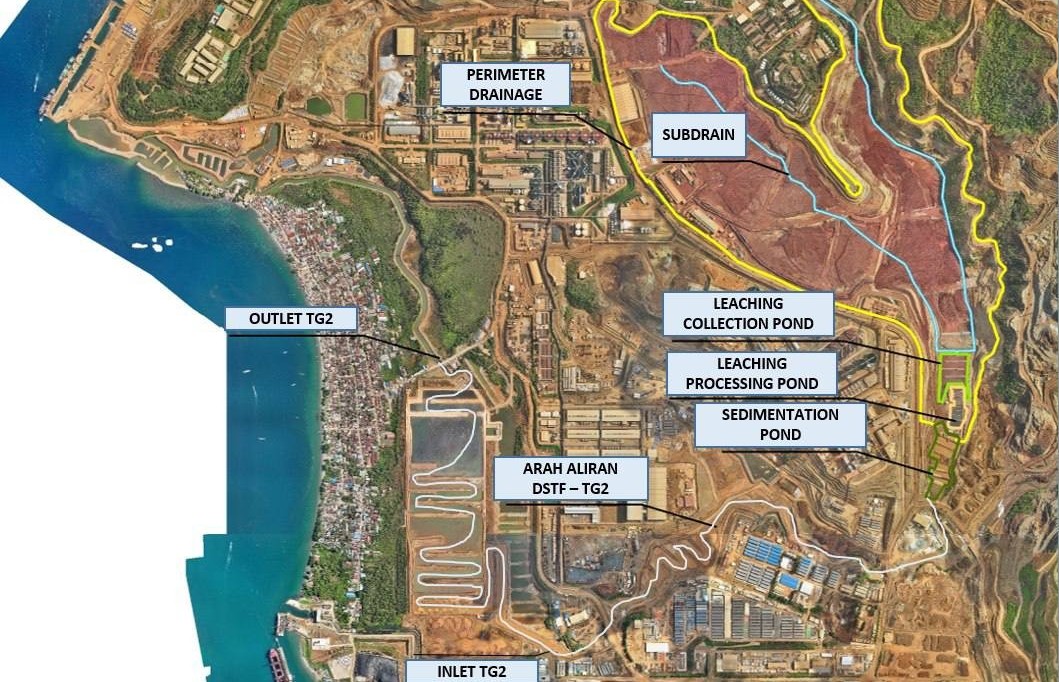
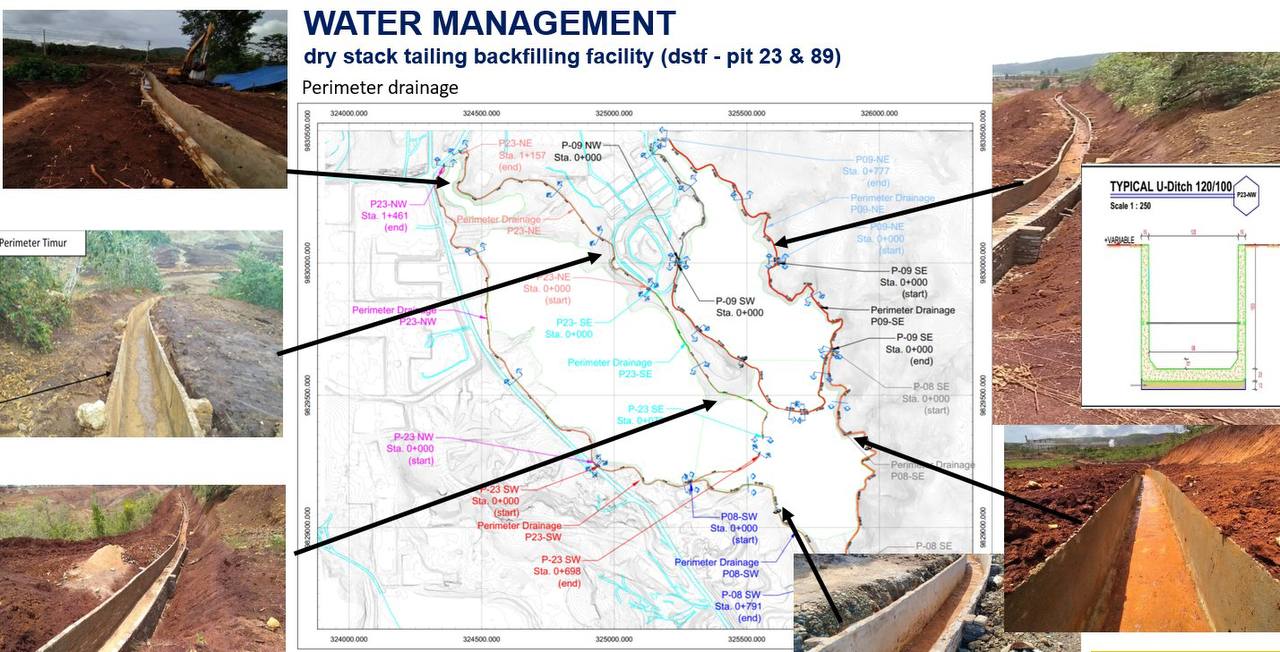
Each buttress is integrated with a drainage system to control water flow within the stack, from surface channels to sub-surface levels. In this way, potential seepage is mitigated. The collected water is then directed to leachate treatment ponds and processed to meet regulatory environmental standards.
By-Product Utilization in the Circular Economy Framework
Amid the increasingly evident challenges of climate change, including potential increases in rainfall, the company continues to adapt to ensure that tailings management remains safe and sustainable. One strategic step taken is the operation of the Anyer–Bantimurung–Senggigi (ABS) Facility, which uses mined-out pits to place wet tailings via backfilling.
By adopting Tailing Storage Facility (TSF) technology equipped with dewatering systems, this facility is designed to maintain stability while increasing operational flexibility.
More than just waste management, ABS is part of the company’s efforts to apply circular economy principles. Tailing from the production process is channeled to utilization facilities, where the substantial contained iron (Fe) is reprocessed into valuable raw material. This approach not only reduces the volume of tailings to be stored but also helps conserve natural resources, reduces the need for new raw materials, and lowers the carbon footprint and land use.
These efforts have shown significant results. With a utilization capacity of up to 58 million cubic meters of wet tailings, the company can reduce stack volume while increasing the material’s added value. Additionally, water pumped from the ABS facility is reused in the production process, creating energy and water usage efficiency. Furthermore, the application of this technology contributes to an emission reduction of approximately 28,000 tCO₂ per year and reduces dust potential, especially during the dry season.
Our sustainability commitment also extends to post-mining stages and ecosystem protection. Nickel slag is utilized in land rehabilitation activities in reclamation areas as a soil ameliorant to help improve fertility. In the marine environment, the Reefcube innovation utilizes processed nickel slag as artificial reef structures. Various scientific studies show that these structures can support new coral growth and increase marine biodiversity.
All these initiatives are carried out in reference to applicable regulations and are supported by thorough technical studies. Through consistent monitoring and evaluation, the company ensures that every step taken is not only safe and effective but also aligned with long-term commitments to responsible and sustainable mining practices.
Transparency as a Catalyst for Improvement
We view transparency not as an option, but as the foundation of responsible management. In an interconnected system—between operations, the environment, and the community—every waste management practice must be transparently accountable to stakeholders.
Therefore, we consistently open ourselves to independent audits and regulatory reviews. We do not view this process merely as a compliance obligation but as an essential mechanism to continuously test, improve, and strengthen the system. We also encourage active collaboration with regulators and the community as part of our efforts to build trust.
We believe that responsible mining can only be realized through a science-based approach, genuine transparency, and a firm commitment to environmental stewardship.