Annual Report 2025
Annual Report 2025
Strengthening Fundamentals for Sustainable Growth
Entering 2025 amid ongoing volatility in the global nickel industry, fluctuating commodity prices, and rising expectations for sustainability and operational efficiency, the Company’s focus is to strengthen its business fundamentals as a prerequisite for long-term sustainable growth. The Company prioritizes the reinforcement of operational fundamentals, supply reliability, cost competitiveness, and investment discipline to maintain business resilience and enhance long-term competitiveness.
These strengthened fundamentals are realized through the optimization of the Company’s mining portfolios, deeper value chain integration, and the stabilization and optimization of downstream projects that have entered the operational phase. In parallel, Environmental, Social, and Governance (ESG) principles are embedded across the Company’s business processes as an integral part of its strategy to create sustainable long-term value for shareholders and all stakeholders.
External Conditions Overview
The Organisation for Economic Co-operation and Development (OECD) projected global economic growth of approximately 3.4% in 2025, slightly lower than the previous year. The moderation was primarily influenced by ongoing geopolitical tensions, rising trade protectionism, and United States industrial policies aimed at strengthening domestic supply chains and reshoring strategic investments.
Amid these dynamics, Indonesia’s economy performed better than expected. While the World Bank had projected average growth of approximately 4.8% during the 2025–2027 period, data from Statistics Indonesia (BPS) showed that Indonesia’s economy expanded by 5.1% in 2025. This growth was supported by resilient domestic demand, stable household consumption, and strong performance in the manufacturing and trade sectors.
Within the critical minerals industry, United States policies such as the Inflation Reduction Act (IRA) have encouraged the use of domestically sourced battery materials and components, as well as those originating from partner countries. These policies have accelerated the restructuring of global battery supply chains and increased requirements related to local content, sustainability, and mineral traceability.
For Indonesia, as the world’s largest nickel producer, these developments present both challenges and opportunities. In addition to pressures arising from global oversupply conditions, shifts in trade policies and industrial strategies among major economies continue to influence investment flows, demand patterns, and global nickel supply chains. At the same time, the expansion of battery supply chains outside China presents opportunities for Indonesia to strengthen strategic partnerships and further develop its downstream industries.
Industry Overview
The global nickel industry continued to face oversupply conditions in 2025 as a result of substantial expansions in mining and processing capacity over recent years. According to the International Nickel Study Group (INSG), the global nickel market is expected to remain in surplus, driven by increasing production of intermediate nickel products such as nickel pig iron (NPI), nickel matte, and Mixed Hydroxide Precipitate (MHP).
On the demand side, nickel consumption continued to be primarily driven by the stainless steel and electric vehicle battery industries. Demand from the stainless steel sector remained positive, although growth moderated compared to the period of rapid property-driven expansion in China. Meanwhile, the continued growth of the electric vehicle market supported nickel demand, particularly in Europe and the United States, where nickel-based battery chemistries remain widely used in high-performance vehicles.
Competition from lithium iron phosphate (LFP) batteries, which have become increasingly dominant in China, is generally viewed as a market segmentation trend rather than a structural decline in the role of nickel. Accordingly, the long-term outlook for nickel demand from the battery sector remains relatively strong.
Beyond supply and demand dynamics, Environmental, Social, and Governance (ESG) considerations have become increasingly important. Global customers are placing greater emphasis on supply chain transparency, environmental compliance, and sustainability certifications. As a result, competitiveness within the nickel industry is no longer determined solely by production costs and output volumes, but also by sustainability performance.
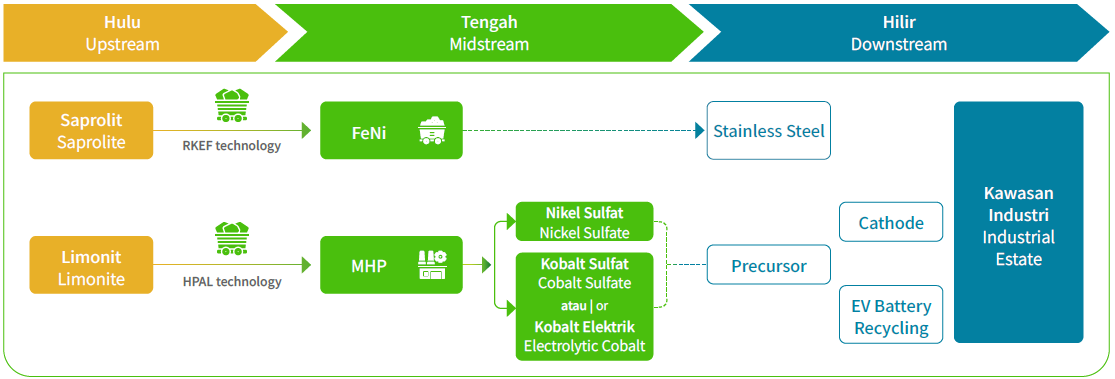
The Company is an integrated nickel producer with operations spanning laterite nickel ore mining and downstream processing through Rotary Kiln Electric Furnace (RKEF) and High Pressure Acid Leach (HPAL) technologies. All operations are centrally located on Obi Island, providing significant logistical efficiencies.
Mining Activities
Mining activities are conducted using the open-cast mining method, producing both high-grade saprolite ore and lower-grade limonite ore. Based on the 2025 Mineral Resources and Ore Reserves (MROR) data, the Company possesses total estimated nickel ore resources and reserves of 310.8 million wet metric tonnes (WMT), comprising 215.1 million WMT of limonite ore and 95.7 million WMT of saprolite ore.
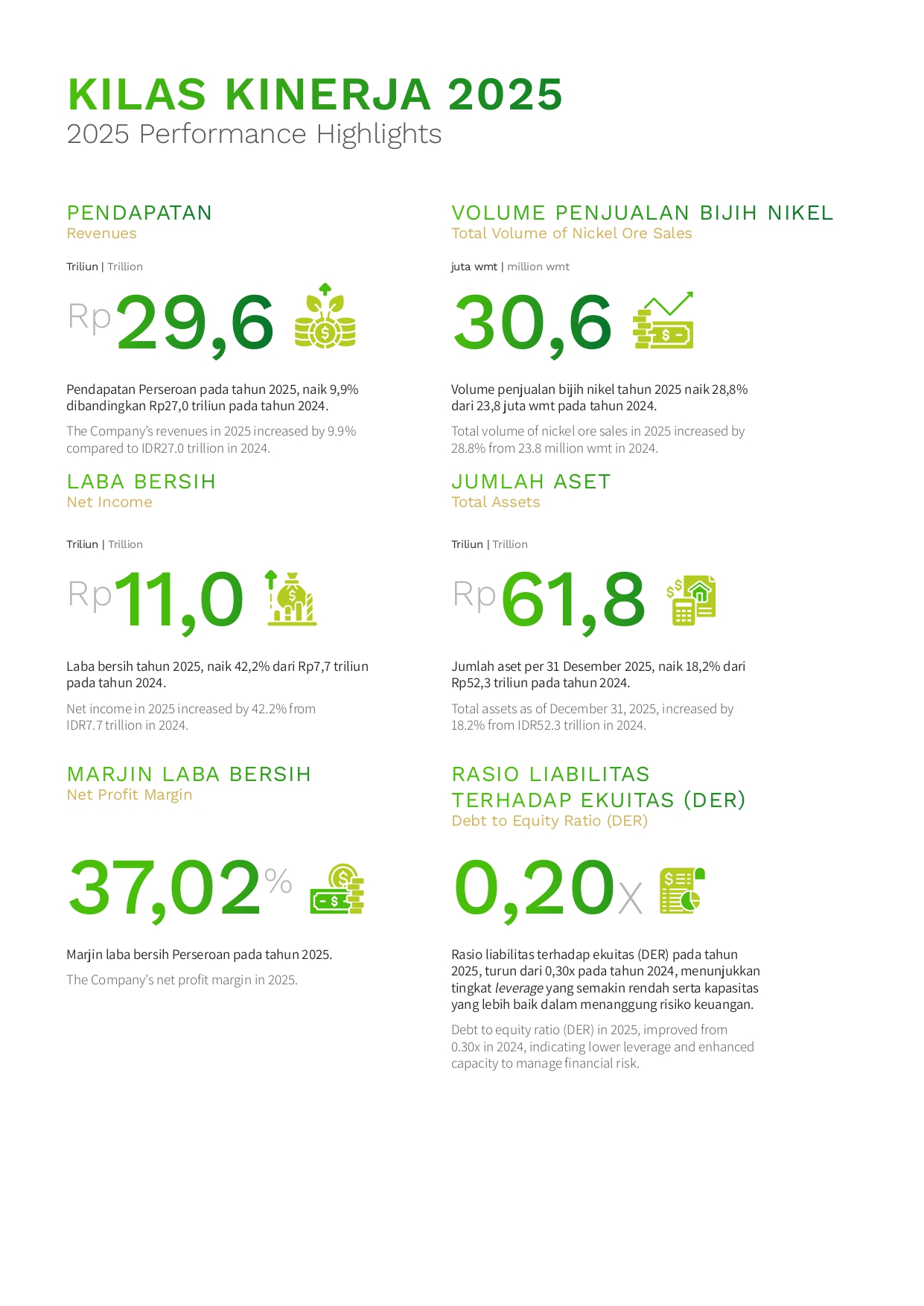
Throughout 2025, nickel ore sales volume reached 30.59 million WMT, representing an increase of 28.8% compared to the previous year. Saprolite ore sales amounted to 12.09 million WMT, up 32.0%, while limonite ore sales reached 18.50 million WMT, increasing by 26.8%.
The increase in saprolite ore sales was primarily driven by the completion of Phase 1 and Phase 2 construction of the PT KPS smelter in 2025. Meanwhile, the growth in limonite ore sales was in line with feedstock requirements for the second HPAL plant, PT ONC, which has been operating at full capacity for one year with three production lines.
Processing Activities
The Company operates three RKEF smelters:
- PT MSP – 4 production lines with an annual capacity of 25,000 tonnes of contained nickel in ferronickel (FeNi)
- PT HJF – 8 production lines with an annual capacity of 95,000 tonnes of contained nickel in ferronickel (FeNi)
- PT KPS – 12 production lines with an annual capacity of 120,000 tonnes of contained nickel in ferronickel (FeNi)
With the commencement of operations of eight production lines at PT KPS during 2025, the combined installed capacity of the Company’s three RKEF smelters reached approximately 240,000 tonnes of contained nickel in ferronickel per annum.
In 2025, sales of Mixed Hydroxide Precipitate (MHP) and its derivative product, nickel sulfate (NiSO₄), reached 130,551 tonnes, representing an increase of 27.9% compared to 102,054 tonnes in 2024.
For limonite ore refining, the Company operates HPAL facilities through PT HPL and PT ONC:
- PT HPL – 3 production lines with an annual capacity of 55,000 tonnes of contained nickel and cobalt metal
- PT ONC – 3 production lines with an annual capacity of 65,000 tonnes of contained nickel and cobalt metal
The combined installed capacity of these facilities totals 120,000 tonnes per annum, including approximately 14,250 tonnes of contained cobalt metal. Sales volume of HPAL products (MHP and NiSO₄) reached 130,551 tonnes in 2025, reflecting continued growth in line with the ramp-up of processing operations.
Certification Progress and Strengthening of International Standard Practices
In response to evolving global ESG expectations, the Company continued to strengthen its commitment to internationally recognized mining and processing practices through the implementation of the Responsible Minerals Initiative – Responsible Minerals Assurance Process (RMI RMAP), enhancement of environmental and safety management systems, and the execution of the Initiative for Responsible Mining Assurance (IRMA) audit process.
2025 Strategy and Initiatives
The Company’s operational resilience remains aligned with management’s strategic priorities, which include securing resource supply, maintaining disciplined upstream-to-downstream integration, strengthening cost competitiveness, enhancing organizational capabilities, and embedding ESG considerations into business decision-making processes.
Throughout 2025, these strategies were translated into concrete actions focused on operational efficiency, the advancement of internationally recognized practices, and the enhancement of social impact.
This financial review has been prepared based on the Consolidated Financial Statements of the Company and its Subsidiaries for the year ended December 31, 2025, which have been audited by Purwantono, Sungkoro & Surja Public Accounting Firm and received an unqualified opinion.The financial statements present fairly, in all material respects, the consolidated financial position of the Company as of December 31, 2025, as well as its consolidated financial performance and cash flows for the year then ended, in accordance with Indonesian Financial Accounting Standards.This financial review should be read in conjunction with the Notes to the Consolidated Financial Statements, which form an integral part of this Annual Report.
Consolidated Statement of Financial Position
Assets
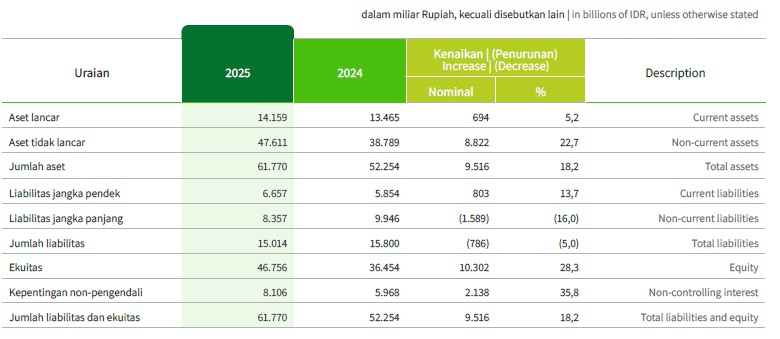
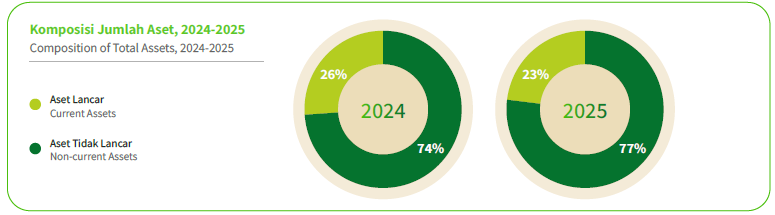
As of December 31, 2025, the Company’s total assets amounted to Rp 61,770 billion, representing an increase of 18.2% compared to Rp 52,254 billion in the corresponding period of the previous year. This growth was driven by increases in both current assets and non-current assets, which rose by 5.2% and 22.7%, respectively.
Composition of Total Assets, 2024–2025
Current Assets
Current assets amounted to Rp 14,159 billion, an increase of 5.2% compared to Rp 13,465 billion in 2024. The increase was primarily driven by a 25.7% rise in trade receivables, from Rp 1,542 billion to Rp 1,938 billion, as well as a 13.9% increase in inventories, from Rp 5,158 billion to Rp 5,876 billion. Conversely, cash and cash equivalents declined by 7.2%, from Rp 6,486 billion to Rp 6,016 billion, mainly reflecting cash utilization to support investment expansion, particularly in Associates, as well as dividend payments and the partial repayment of long-term bank loans.
Non-Current Assets
Non-current assets amounted to Rp 47,611 billion, an increase of 22.7% compared to Rp 38,789 billion in 2024. This increase was primarily attributable to higher investments in Associates, in line with their stronger financial performance.
Liabilities
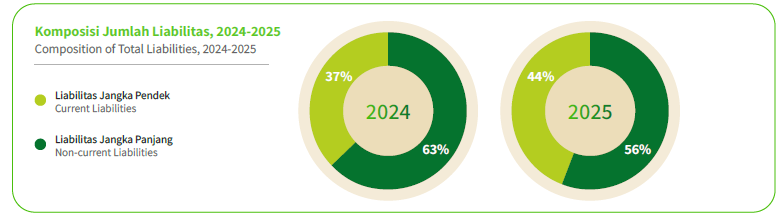
As of December 31, 2025, the Company’s total liabilities amounted to Rp 15,014 billion, representing a decrease of 5.0% compared to Rp 15,800 billion in the corresponding period of the previous year. This decline was primarily attributable to a 16.0% reduction in non-current liabilities, partially offset by a 13.7% increase in current liabilities.
Composition of Total Liabilities, 2024–2025
Current Liabilities
Current liabilities amounted to Rp 6,657 billion, an increase of 13.7% compared to Rp 5,854 billion in 2024. The increase was primarily driven by:
- A 45.1% increase in trade payables, from Rp 1,246 billion to Rp 1,808 billion;
- A 135.2% increase in accrued expenses, from Rp 105 billion to Rp 247 billion;
- A 59.5% increase in short-term employee benefits liabilities, from Rp 158 billion to Rp 252 billion; and
- An 11.7% increase in short-term bank loans, from Rp 1,672 billion to Rp 1,867 billion.
Non-Current Liabilities
Non-current liabilities amounted to Rp 8,357 billion, a decrease of 16.0% compared to Rp 9,946 billion in 2024. The decline was primarily attributable to a 17.7% reduction in long-term bank loans, which decreased from Rp 9,130 billion to Rp 7,514 billion.
Equity
As of December 31, 2025, the Company’s total equity amounted to Rp 46,756 billion, representing an increase of 28.3% compared to Rp 36,454 billion in the corresponding period of 2024. This increase was primarily driven by a 58.4% rise in retained earnings, which grew from Rp 12,074 billion to Rp 19,126 billion, as well as an 82.3% increase in other comprehensive income, from Rp 1,443 billion to Rp 2,630 billion.
Consolidated Statement of Profit or Loss and Other Comprehensive Income
Revenue from Contracts with Customers
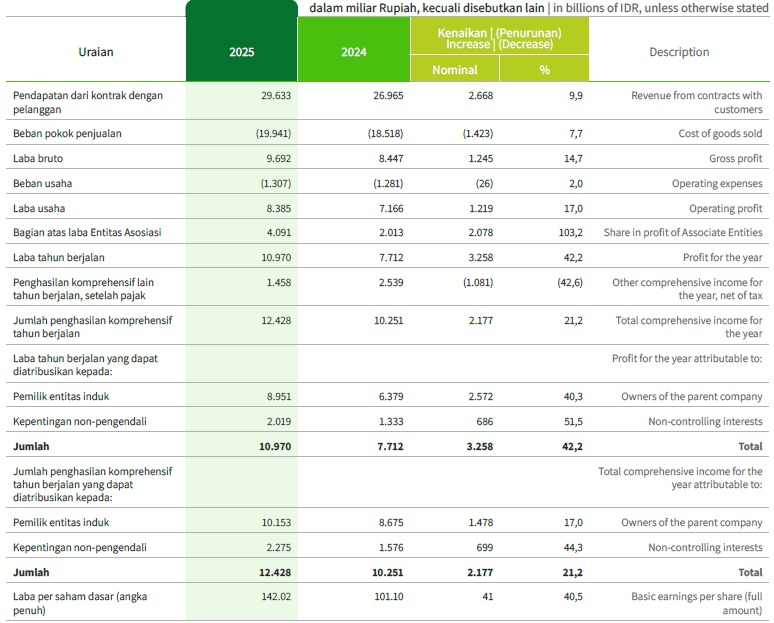
The Company recorded revenue from contracts with customers of Rp 29,633 billion in 2025, representing an increase of 9.9% compared to Rp 26,965 billion in 2024.
This revenue was generated from the nickel mining segment, which contributed Rp 7,178 billion, an increase of 88.8% compared to Rp 3,801 billion in the previous year, while the nickel processing segment contributed Rp 22,455 billion, a decrease of 3.1% compared to Rp 23,164 billion in 2024.
Cost of Revenues
Cost of revenues amounted to Rp 19,941 billion, an increase of 7.7% compared to Rp 18,518 billion in the previous year. This increase was in line with higher production costs, both direct and indirect, driven by increased production volumes.
The increase in direct production costs was primarily attributable to higher raw material costs, mining activities, and direct labor expenses. Meanwhile, the increase in indirect production costs mainly resulted from higher depreciation expenses on fixed assets, repairs and maintenance costs, fabrication expenses, as well as taxes and licensing fees.
Gross Profit
The Company recorded gross profit of Rp 9,692 billion, representing an increase of 14.7% compared to Rp 8,447 billion in 2024. Gross profit margin also improved from 31.3% to 32.7%, reflecting enhanced operational efficiency and more effective cost management.
Operating Expenses and Operating Profit
Operating expenses increased moderately by 2.0%, from Rp 1,281 billion to Rp 1,307 billion. This increase was primarily attributable to a significant rise in other expenses, from Rp 3 billion to Rp 107 billion, as well as a 78.8% decline in other income, from Rp 312 billion to Rp 66 billion. These increases were partially offset by a 20.4% reduction in selling, general, and administrative expenses.
Despite the increase in operating expenses, the Company maintained strong operating profitability, as reflected in operating profit, which increased by 17.0% to Rp 8,385 billion from Rp 7,166 billion in the previous year.
Share in Profit of Associated Entities
The contribution from Associates increased significantly, with the Company recognizing a share of profit amounting to Rp 4,091 billion, an increase of 103.2% compared to Rp 2,013 billion in the previous year.
Profit for the Year
The Company recorded profit for the year of Rp 10,970 billion in 2025, representing an increase of 42.2% compared to Rp 7,712 billion in 2024.
Total Comprehensive Income for the Year
The Company recorded other comprehensive income of Rp 1,458 billion in 2025, a decrease of 42.6% compared to Rp 2,539 billion in 2024. The decline was primarily attributable to the absence of changes in the fair value of financial assets measured at fair value through other comprehensive income, compared to a contribution of Rp 1,513 billion in the previous year.
As a result, total comprehensive income for the year amounted to Rp 12,428 billion, representing an increase of 21.2% compared to Rp 10,251 billion in 2024.
Statements of Consolidated Cash Flows
Cash Flows from Operating Activities
Cash flows from operating activities were primarily generated from cash receipts from customers amounting to Rp29,269 billion (2024: Rp 26,082 billion), as well as receipts from interest income, tax refunds, and other income totaling Rp 489 billion (2024: Rp641 billion).
These cash inflows were utilized for payments to suppliers amounting to Rp15,189 billion (2024: Rp15,698 billion), payments to employees of Rp2,729 billion (2024: Rp2,665 billion), payments for other operating expenses of Rp568 billion (2024: Rp668 billion), income tax payments of Rp1,224 billion (2024: Rp1,142 billion), and royalty payments to the Government amounting to Rp1,446 billion (2024: Rp842 billion).
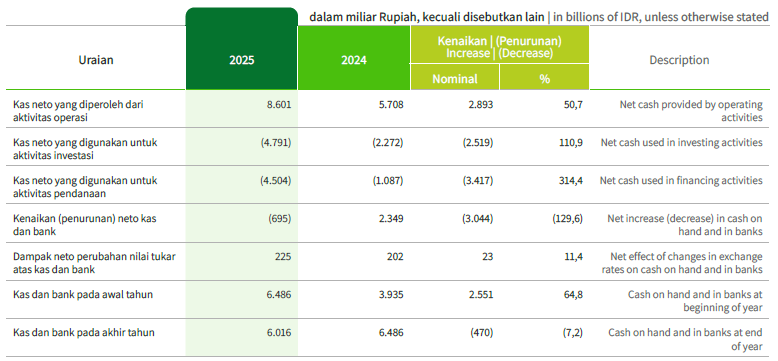
As a result, the Company recorded net cash generated from operating activities of Rp8,601 billion in 2025, a significant increase compared to Rp5,708 billion in 2024. This improvement was primarily driven by higher cash receipts from customers and the optimization of payments to suppliers and employees, despite increased royalty payments in line with stronger operational performance.
Cash Flows from Investing Activities
Cash flows from investing activities were primarily generated from dividend receipts from Associates amounting to Rp 1,980 billion (2024: Rp 1,438 billion), as well as proceeds from asset disposals and other transactions totaling Rp2 billion (2024: Rp 86 billion).
These cash inflows were utilized for additional investments in Associates amounting to Rp5,085 billion (2024: Rp2,311 billion), investments in debt instruments of Rp750 billion (2024: nil), and acquisitions of fixed assets and the development of other operational assets amounting to Rp939 billion (2024: Rp1,305 billion).
Cash Flows from Financing Activities
Cash flows from financing activities were primarily generated from proceeds of short-term bank loans amounting to Rp 492 billion (2024: Rp 1,585 billion). In 2025, the Company did not draw down any long-term bank loans nor increase restricted cash balances, in contrast to the previous year, when total additions from these funding sources amounted to Rp 11,971 billion.
These cash inflows were utilized for dividend payments to shareholders amounting to Rp1,914 billion (2024: Rp1,686 billion), repayments of long-term bank loans amounting to Rp1,716 billion (2024: Rp8,816 billion), finance cost payments of Rp650 billion (2024: Rp932 billion), repayments of short-term bank loans amounting to Rp499 billion (2024: Rp2,029 billion), and other financing activities totaling Rp217 billion (2024: Rp1,180 billion).
As a result, the Company recorded net cash used in financing activities of Rp4,504 billion in 2025, compared to net cash used of Rp1,087 billion in 2024. This primarily reflects the Company’s strategy to reduce debt exposure while continuing to distribute dividends to shareholders.
The Company has established sustainability targets as part of its commitment to ensuring that the management of Environmental, Social, and Governance (ESG) impacts is conducted in a structured, measurable, and strategic manner, aligned with its long-term growth objectives. These targets reflect the Company’s focus on strengthening responsible mining and processing practices, enhancing operational resilience, and expanding its positive contributions to stakeholders.
Throughout 2025, the Company continued to implement a range of sustainability initiatives across climate action, environmental management, human rights, occupational health and safety, community development, and the strengthening of governance and responsible supply chain practices. The following highlights some of the Company’s key sustainability targets and implementation progress during 2025.
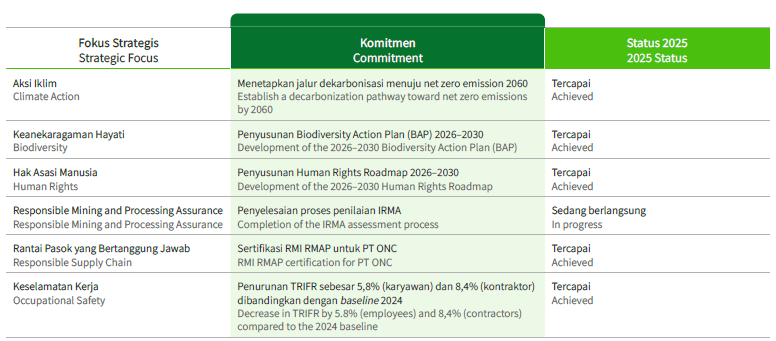
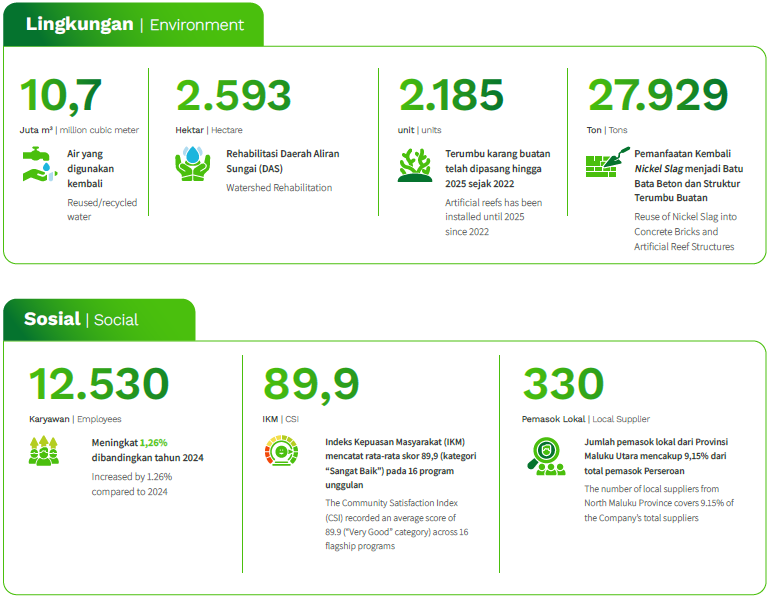
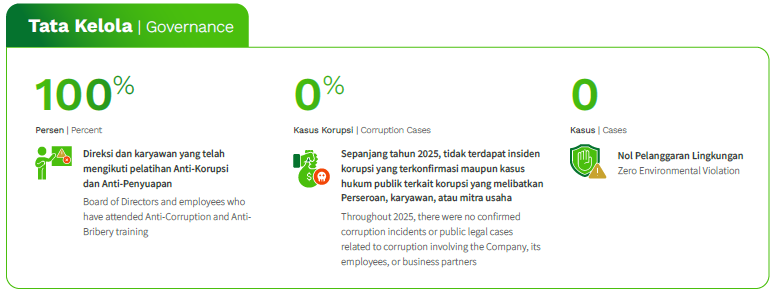
The implementation of the Company’s sustainability strategy throughout 2025 is reflected in various Environmental, Social, and Governance (ESG) performance achievements that support the advancement of responsible mining and processing practices while creating long-term value for stakeholders.