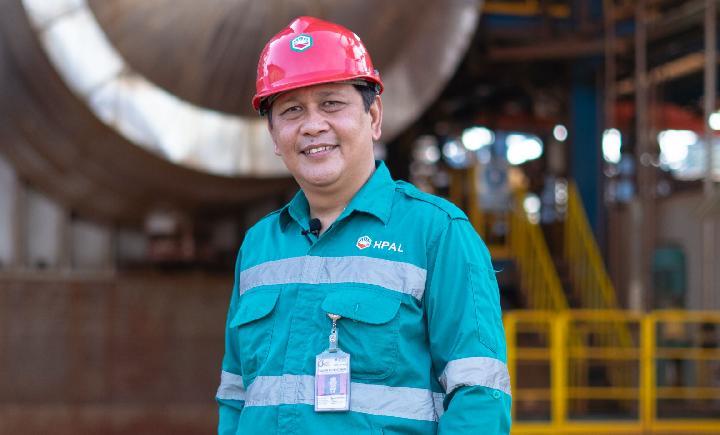
INFO NASIONAL — Rico Windy Albert is the figure behind the successful application of High Pressure Acid Leach (HPAL) technology at Harita Nickel, under the Halmahera Persada Lygend (HPL) banner — one of the company’s nickel processing operations on Obi Island in South Halmahera, North Maluku. His name has been recognized within Indonesia’s electric vehicle battery raw materials industry since June 23, 2021.
“HPAL is a new technology in Indonesia. Until then, no company had successfully implemented it. I questioned at first whether Harita could truly apply it,” recalled Rico, who now serves as the Technical and Environmental Lead (PTL) at HPL. Despite his initial doubts, his determination did not waver. With a Bachelor’s degree in Industrial Engineering from Hasanuddin University and a Master’s in Business Management from Binus University, Rico was driven to make HPAL technology a reality in Indonesia.
Moreover, HPAL is considered more environmentally friendly due to its relatively lower energy use compared to other nickel processing methods. Naturally, this also results in lower emissions. “This is one of Harita Nickel’s contributions toward achieving net zero emissions,” he added. “Our products also play a major role in reducing global vehicle emissions, as they form the raw materials for electric vehicle batteries.”
Since the start of his career, Rico had aspired to see this technology implemented in Indonesia. He had previously spent 25 years at another private mining and nickel processing company, where HPAL development for limonite ore was explored. However, the high investment requirements and significant risk made implementation difficult.
When he learned that Harita Nickel was committed to adopting HPAL technology in one of its processing facilities, Rico was eager to contribute. His journey began in 2019 — a year full of challenges, as HPAL plant construction had only just begun, and a year later the Covid-19 pandemic disrupted the movement of materials and personnel. The implementation also required intensive knowledge transfer between foreign experts and local workers.
“Since this is the first time the technology has been applied in Indonesia, we have had to continue learning,” explains Rico. “Knowledge and technology transfer has been ongoing from construction to operations and continues to this day,” he added.
Halmahera Persada Lygend (HPL) is a joint venture between Harita and Lygend Resource Technology Co., Ltd. “The application of this technology provides Indonesian talent with the opportunity to learn something new,” he emphasized — a father of three daughters.
As a leader, Rico recognizes that adapting to different work cultures and characteristics is also a challenge he and his team face. However, these challenges were eclipsed by the milestone of the first production of Mixed Hydroxide Precipitate (MHP) on June 23, 2021. Completing construction and moving to production in around 28 months is an achievement in itself for this Rp15 trillion project.
Previously, limonite ore was not utilized due to its very low nickel content (<1.5%) and was classified as ‘overburden’. “But today, it holds strategic value and is in high demand among electric vehicle battery manufacturers worldwide,” Rico added.
The success achieved by Harita Nickel through Halmahera Persada Lygend has opened the door for Indonesia to assert itself further as a leading global player in the electric vehicle battery industry. “Harita Nickel is a pioneer in Indonesia — not only in processing and refining low-grade nickel ore using HPAL technology, but also in positioning Indonesia one step ahead as a respected producer of electric vehicle battery raw materials,” said Rico.
HPAL technology enables the utilization of low-grade limonite ore, providing it with economic value where previously it had none, and supporting mineral conservation efforts. The process uses sulfuric acid as a processing agent to produce Mixed Hydroxide Precipitate (MHP), which is then further refined into nickel sulfate and cobalt sulfate — key raw materials for electric vehicle batteries.
Optimizing Domestic Natural Resources
Home to some of the world’s largest nickel reserves, Indonesia has significant potential to optimize the management of its natural resources. With its nickel mineral reserves, Indonesia can contribute to reducing global emissions, particularly in the transportation sector, by supporting the shift from fossil-fueled vehicles to electric vehicles.
Even as a pioneer in processing nickel into electric vehicle battery materials, Rico acknowledges that similar companies will follow and produce similar products. Therefore, he and his team remain committed to continuous innovation together with Harita Nickel and its affiliates, in developing an advanced downstream nickel industry in Obi Island, North Maluku.
Source: Tempo Nasional