
Occupational Health Safety
Occupational Health Safety
|
Occupational health and safety (OHS) is our top priority, reflecting our commitment to upholding human rights and ensuring sustainable operations. |
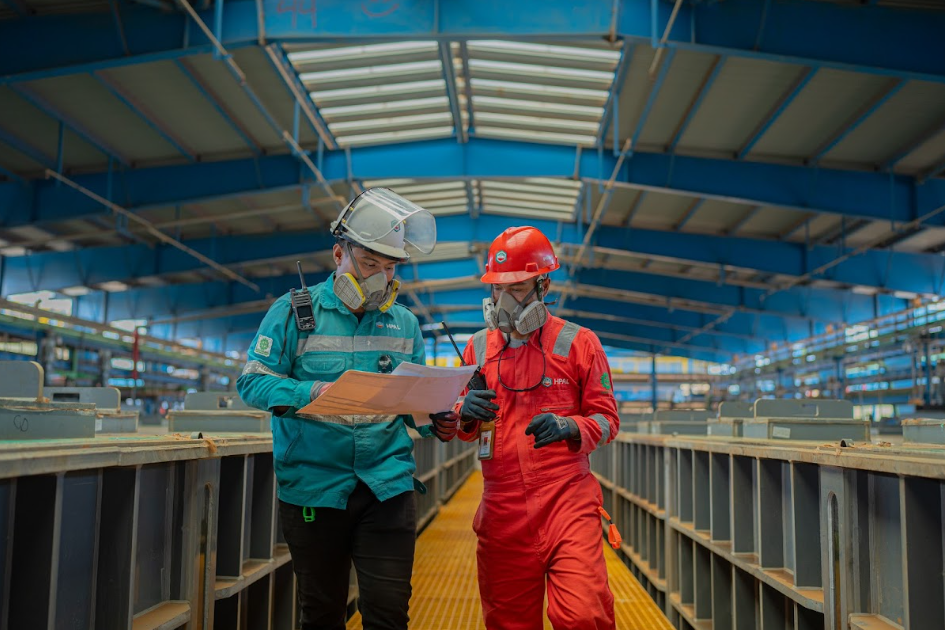 |

At Harita Nickel, occupational safety and health (OHS) go beyond mere regulatory compliance; they are integral to the work culture we continue to nurture. We believe that building a skilled workforce in OHS is a crucial step toward creating a safer, more productive, and sustainable work environment.
As part of this commitment, we have implemented strategic initiatives to ensure that every employee understands the potential hazards and risks in the workplace, is equipped to manage them effectively, and reports them according to established procedures.
a. Enhancing Personnel Competence for HSE Awareness
-
Development of an Integrated Management System (IMS)
Harita Nickel has developed an Integrated Management System (IMS) that consolidates various management systems, including ISO 45001 (Occupational Health and Safety), ISO 14001 (Environment), and ISO 26000 (Social Responsibility). This IMS serves as the primary guideline for all employees in implementing safe, efficient, and responsible work practices regarding occupational health and safety, environmental sustainability, and social responsibility.
-
HSE-Based Competency Mapping
As a concrete step towards enhancing HSE awareness, we have developed a Standard Competency Mapping aligned with the Human Resources (HR) system. Through this approach, we ensure that every worker has a deep understanding of:
-
-
Identifying workplace hazards and implementing appropriate mitigation measures.
-
Applying safe work procedures in accordance with HSE regulations.
-
Reporting incidents and unsafe conditions (unsafe conditions & unsafe acts) quickly and accurately.
-
b. HSE Competency Development Strategy Across All Business Units
We have formulated a Competency Development Strategy that encompasses all Business Units (BUs) with an integrated and collaborative approach. This strategy ensures that each business unit adopts standardized HSE training methods, enabling all employees to proactively recognize risks and uphold workplace safety.
c. Comprehensive HSE Awareness Campaigns
To strengthen the safety culture, Harita Nickel regularly conducts campaigns and socialization programs on the Integrated Management System (IMS) with a focus on HSE. These initiatives incorporate various methods, including:
-
HSE training and certification for all employees and contractors.
-
Workshops and emergency response simulations to enhance incident preparedness.
-
Socialization of hazard and incident reporting procedures through multiple internal communication channels.
Harita Nickel understands that the health and safety of communities around our operational areas are fundamental to our business sustainability. Thus, we are committed to balancing industrial activities with community well-being through data-driven and participatory initiatives.
a. Community Health Assessment for Risk Mitigation
As part of our environmental and social responsibility, we have conducted a Health and Socio-Economic Impact Assessment in Obi Island in collaboration with the Environmental Study Center of Gadjah Mada University (UGM).
This independent study, involving local communities, aims to:
-
Identify potential public health impacts arising from industrial activities.
-
Assess environmental and social risk factors affecting community well-being.
-
Develop data-driven prevention and risk control strategies to ensure harmonious company-community relations.
b. Implementation of Community Health Programs
Harita Nickel collaborates with Khairun University in Ternate to implement various community health improvement programs, including:
-
Basic Life Support Training: Educating communities on first aid, including CPR, choking response, and emergency medical handling before professional help arrives.
-
Public Health Awareness & Hygiene Education (PHBS): Raising awareness about the importance of hygiene and disease prevention through proper handwashing, environmental cleanliness, and healthy lifestyle habits.
-
Food Hygiene & Sanitation Analysis: Assessing community food safety standards to prevent contamination risks that may endanger public health.
c. Community Involvement in Emergency Response & Crisis Management (ERCM)
Harita Nickel has developed an Emergency Response and Crisis Management (ERCM) System involving local communities as part of the emergency response framework, which includes:
-
Emergency preparedness training to enhance disaster response readiness.
-
Establishing emergency communication systems for fast and accurate crisis information dissemination.
-
Collaboration with external agencies such as BPBD, BNPB, and local medical teams to ensure an effective and well-coordinated response.
Harita Nickel believes industrial growth must align with the well-being of surrounding communities. Therefore, we continuously evaluate and improve community health and safety management through:
-
Sustainable social responsibility
-
Scientific-based risk mitigation approaches
-
Active collaboration with stakeholders
We recognize that workplace safety is not just an internal responsibility but extends to our entire operational ecosystem, including contractors working within our facilities.
To align with ISO 45001 (Occupational Health and Safety Management System), ESG (Environmental, Social, and Governance) principles, and best practices in the mining industry, we have developed a comprehensive Contractor Safety Management System.
a. Pre-Qualification and Selection
-
Evaluating safety records to ensure compliance with OHS regulations.
-
Reviewing safety documents, including policies, certifications, and insurance.
-
Conducting field audits and verifying operational capabilities before hiring contractors.
b. Contract & Pre-Work Planning
-
Integrating safety requirements into work contracts.
-
Holding Pre-Job Safety Meetings to discuss specific procedures and risks.
-
Conducting Job Safety Analysis (JSA/JHA) and safety training for contractors.
c. Execution & Work Monitoring
-
Conducting regular safety inspections and audits based on work risk levels.
-
Implementing a Permit-to-Work system for high-risk activities.
-
Establishing incident reporting and structured corrective action mechanisms.
d. Post-Work Evaluation & Continuous Improvement
-
Evaluating contractor safety performance before project completion certification.
-
Documenting and reporting safety records for future reference.
-
Applying continuous improvement principles in contractor management.
We believe that effective contractor management starts with selecting partners committed to workplace safety. Therefore, we continuously enhance our system to prevent workplace incidents, improve operational efficiency, and ensure safer and more responsible business sustainability.
As a leader in the integrated nickel mining industry, Harita Nickel is committed to prioritizing Occupational Health, Safety, and Environmental (OHSE) management across all operations. We recognize the unique challenges of the mining industry, including natural disasters and operational risks, making a robust disaster management system a top priority.
To ensure preparedness and a swift response to emergencies, we have developed an Integrated Disaster and Emergency Management Manual based on international standards, including ISO 45001, ISO 14001, the Sendai Framework for Disaster Risk Reduction, and the UNEP APELL (Awareness and Preparedness for Emergencies at Local Level) approach. This framework encompasses:
-
Risk Identification & Proactive Prevention
We implement a comprehensive risk identification system to detect potential hazards, whether geological, operational, or environmental. Through in-depth analysis, we take effective mitigation measures to minimize disaster impacts. -
Emergency Preparedness & Response System Based on UNEP APELL
We adopt the UNEP APELL principles, emphasizing coordination between industries, government, and local communities for emergency preparedness. This approach ensures that Harita Nickel not only safeguards its workers and assets but also contributes to strengthening community resilience against disasters. -
Effective Emergency Response Structure
Our emergency response structure follows the Incident Command System (ICS), ensuring seamless coordination between internal teams and external agencies such as the Regional Disaster Management Agency (BPBD), the National Disaster Management Agency (BNPB), the National Search and Rescue Agency (Basarnas), and the Meteorology, Climatology, and Geophysics Agency (BMKG) in handling emergencies. -
Regular Training & Simulations
We conduct large-scale emergency simulations regularly to ensure optimal preparedness among workers, emergency response teams, and business partners. -
Post-Disaster Recovery & Operational Continuity
As part of our commitment to sustainability, Harita Nickel ensures rapid and effective post-disaster recovery, prioritizing worker safety, environmental protection, and operational continuity.