.jpg&w=3840&q=75)
Managing tailings from the High Pressure Acid Leaching (HPAL) process requires more than technology alone. It depends on how facilities are designed, operated, monitored, and continuously improved. An effective approach requires a strong understanding of environmental characteristics, robust governance frameworks, and the right operational capabilities to ensure safe and responsible management.
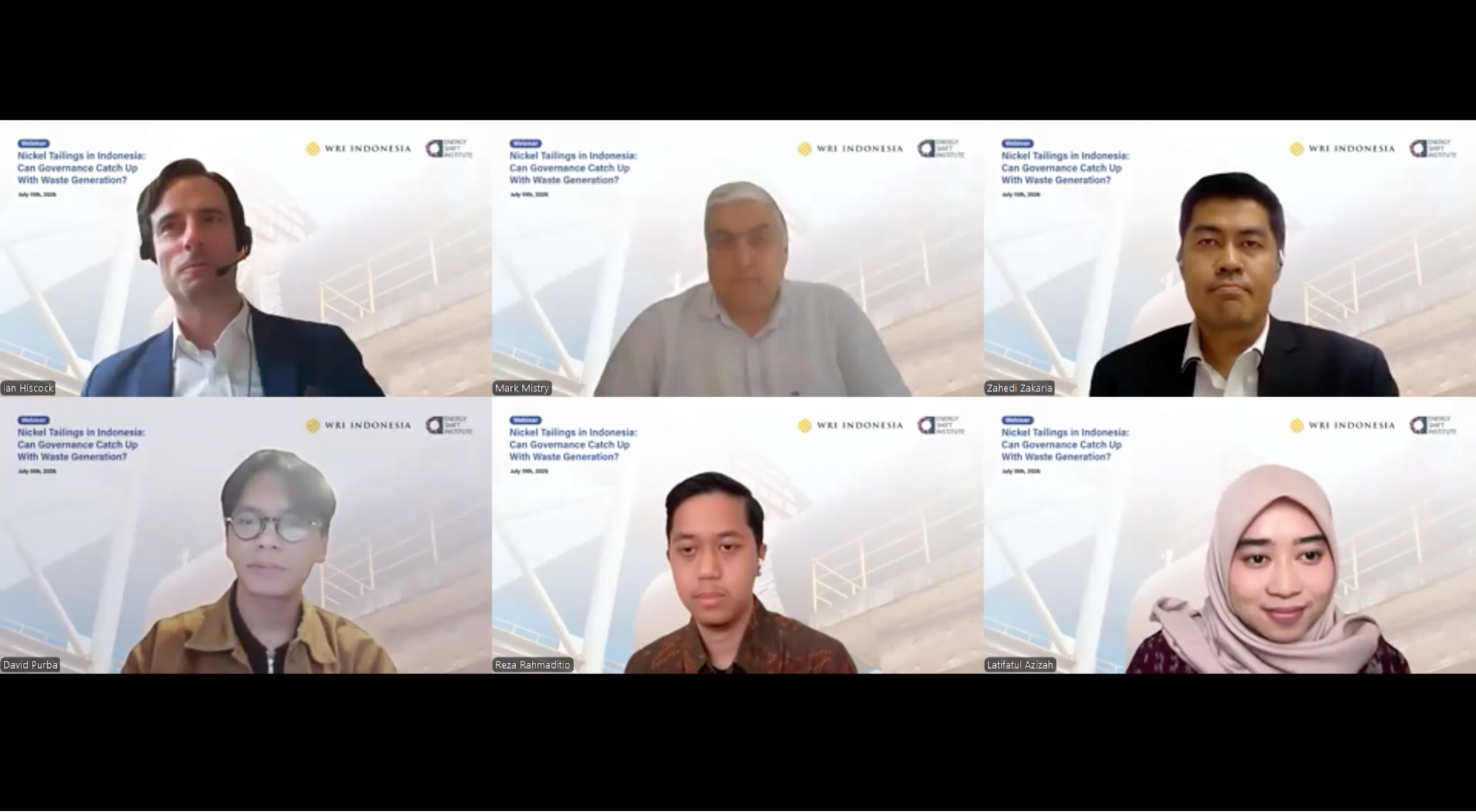
This approach was explored during the webinar “Indonesia’s Nickel Tailings: Can Governance Catch Up Before the Waste Does?” hosted by the World Resources Institute (WRI) Indonesia in collaboration with the Energy Shift Institute on 15 July 2026. During the forum, Harita Nickel ESG Transformation Manager Zahedi Zakaria shared the company’s experience in managing HPAL tailings through an integrated approach that combines technology, governance, and continuous capability building.
As the HPAL-based nickel industry continues to expand, tailings management has become an increasingly important aspect of responsible mining operations. Generated as a residual material from mineral processing, tailings require a management system designed to minimize risks, support operational reliability, and provide long-term environmental protection.
One of the approaches implemented by Harita Nickel is the Dry Stack Tailings Facility (DSTF). Through this method, the tailings' water content is reduced through filtration, allowing the material to be stored in a more stable solid form. This approach helps reduce potential environmental risks, enables the reuse of filtered water in industrial processes, and improves the overall stability of the storage facility compared with conventional wet tailings storage approaches.
According to Zahedi, responsible tailings management is not solely determined by the technology being used, but also by how the technology is designed, operated, and adapted to the characteristics of the operating environment.
"Responsible tailings management is not only determined by the technology being used, but also by how the technology is designed and operated according to environmental characteristics and local conditions. Therefore, strong governance and operational capabilities must advance together," Zahedi said.
He added that each operational area has different geological, hydrological, and environmental characteristics. Therefore, tailings management approaches must be tailored to local conditions to ensure safe and effective implementation.
This perspective aligns with a WRI Indonesia study that compares national regulatory frameworks with several international standards, including the International Finance Corporation (IFC) Performance Standards, Initiative for Responsible Mining Assurance (IRMA), and Responsible Minerals Initiative (RMI). The study highlights the importance of strengthening governance frameworks while continuing to consider local environmental and operational contexts.
During the webinar, WRI Indonesia also recognized the implementation of the Dry Stack Tailings Facility (DSTF) at Harita Nickel’s operational area on Obi Island.
"Only a few companies in Indonesia have facilities like Harita Nickel’s Dry Stack Tailings Facility. I highly appreciate Harita’s efforts. Based on its performance, this represents one of the notable examples of DSTF implementation in Indonesia," said David Purba, Decarbonisation Analyst at WRI Indonesia.
For Harita Nickel, the recognition serves as motivation to continuously strengthen its tailings management practices through ongoing evaluation, capability development, and collaboration with various stakeholders. The company believes that responsible tailings management is not only about applying the right technology, but also about ensuring that every process is carried out safely, responsibly, and in line with sustainable mining principles.