Annual Report 2024
Annual Report 2024
Strategic Growth through Sustainable Expansion
The Company’s core strategy in responding to various industry challenges is to reinforce its commitment to sustainability, enhance operational efficiency, optimize mining performance to ensure a reliable supply of nickel ore for downstream industries within its value chain, and continue strengthening value chain integration on Obi Island through the sustainable expansion of nickel downstreaming.
The Company remains committed to making prudent investments, both to increase production capacity and to develop higher value-added nickel products, while maintaining sound financial performance to support long-term strategic growth.
The following financial review is prepared based on information acquired from the Consolidated Financial Statements of Company and its Subsidiaries dated December 31, 2024 and for the year then ended, which has been audited by the Purwantono, Sungkoro & Surja Public Accounting Firm with the opinion being presented fairly in all material respects, consolidated financial position of the Company as of December 31, 2024, and its consolidated financial performance and cash flows for the year then ended, in accordance with Indonesian Financial Accounting Standard. Understanding the following financial review description also takes into account the explanation presented in the Consolidated Financial Statements as an integrated part of this Annual Report.
Consolidated Statement of Financial Position

Assets
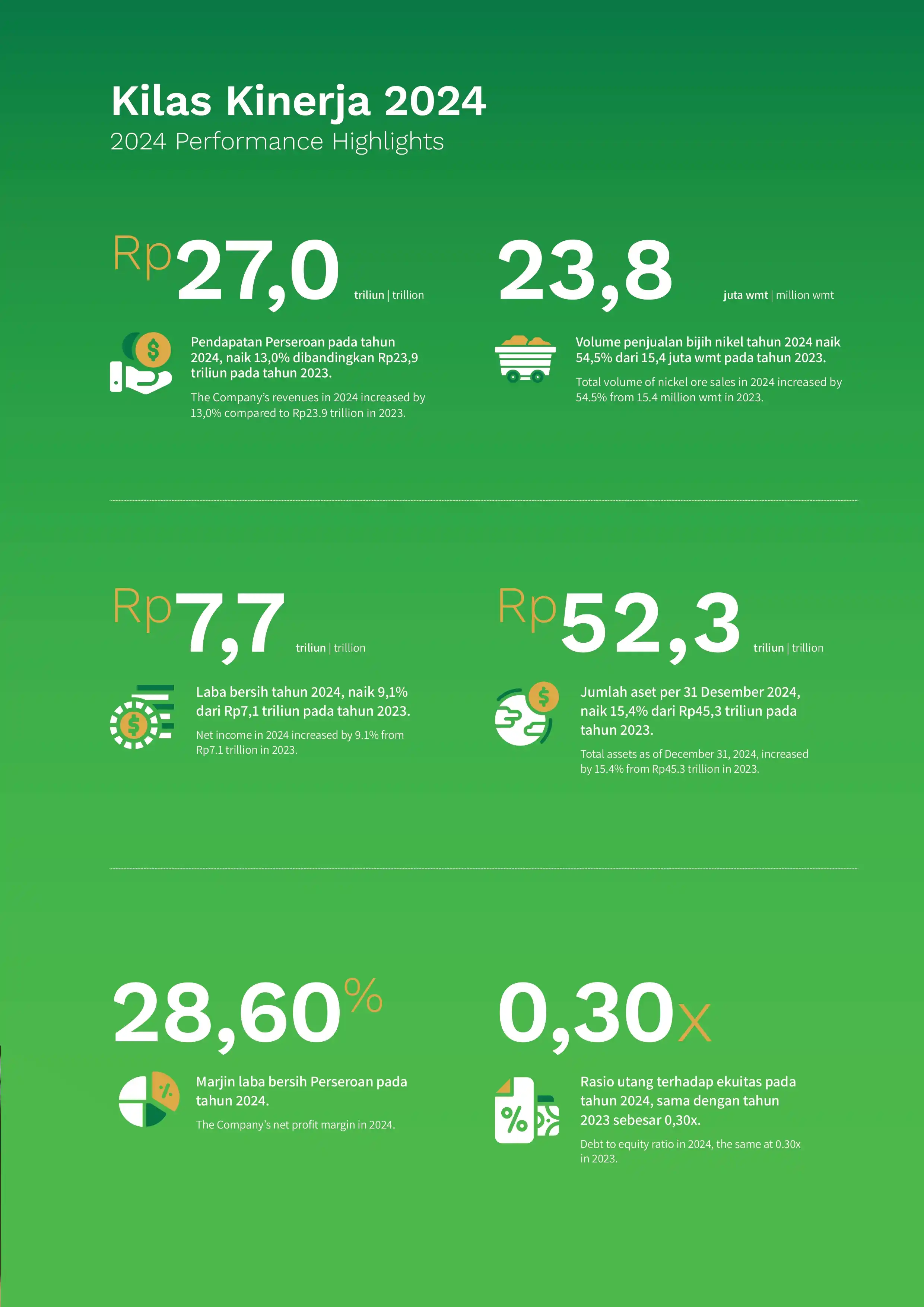
The Company’s total assets as of December 31, 2024 amounted to IDR52,254 billion, increase 15.4% from IDR45,289 billion in the same period the previous year. The increase in total assets was due to an increase in current assets and non-current assets, respectively by 14.5% and 15.7%.
Composition of Total Assets, 2023–2024

Current Assets
Current assets amounted to IDR13,465 billion, increased by 14.5% from IDR11,759 billion in 2023. The increase in current assets mainly came from cash and banks which increased by 64.9% from IDR3,935 billion to IDR6,486 billion due to increased receipts from customers.
Non-Current Assets
Non-current assets amounted to IDR38,789 billion, increase 15.7% from IDR33,530 billion in 2023. The increase in non-current assets was mainly due to investment in Associated Entities.
Liabilities
The Company’s total liabilities as of 31 December 2024 amounted to IDR15,800 billion, decreased by 6.5% from IDR16,897 billion in the same period the previous year. The decrease in total liabilities was mainly due to a decrease in current liabilities by 37.1%. While noncurrent liabilities increased by 31.0%.
Composition of Total Liabilities, 2023–2024

Current Liabilities
Current liabilities totaled IDR5,854 billion, a 37.1% decrease from IDR9,306 billion in 2023. This decline was primarily driven by:
-
- Trade payables decreased by 33.4% from IDR1,871 billion to IDR1,246 billion.
- Other payables decreased by 36.5% from IDR3,606 billion to IDR2,289 billion.
- The repayment of short-term bank loans in 2024.
Non-Current Liabilities
Non-current liabilities amounted to IDR9,946 billion, up 31.0% from IDR7,591 billion in 2023. The increase in non-current liabilities was mainly due to increase in long-term bank loans amounted to 35.2% from IDR6,751 billion to IDR9,130 billion.
Equity
The Company’s total equity as of 31 December 2024 was IDR36,454 billion, up 28.4% compared to IDR28,392 billion in the same period in 2023. The increase in equity was primarily driven by additional retained earnings of IDR6,380 billion and other comprehensive income of IDR753 billion.
Consolidated Statement of Profit or Loss and Other Comprehensive Income

Revenue from Contracts with Customers
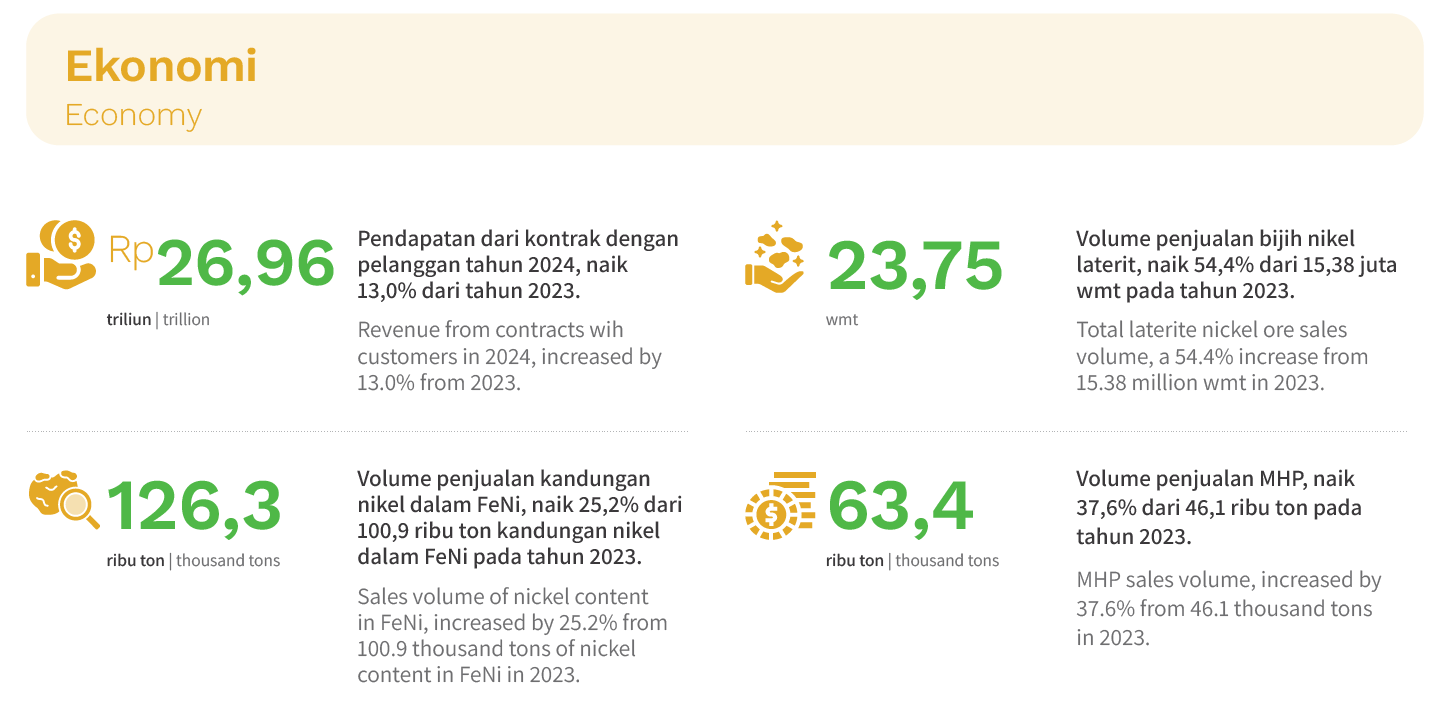
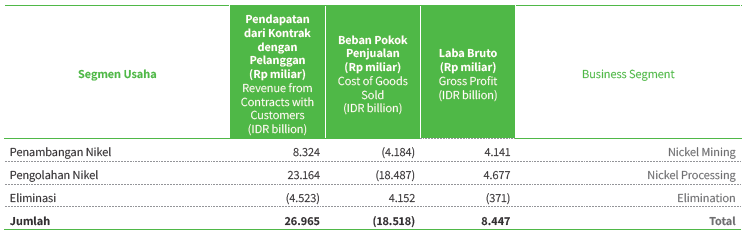
The Company recorded revenue from contracts with customers of IDR26,965 billion, increased by 13.0% compared to IDR23,858 billion in 2023.
This revenue derived from nickel processing business segment amounted to IDR23,164 billion, increased 11.6% from IDR20,765 billion and nickel mining business segment amounted to IDR3,801 billion, increased by 22.9% from IDR3,093 billion in 2023.
Cost of Sales
Cost of Sales amounted to IDR18,518 billion, increased by 18.8% from IDR15,582 billion in the previous year. The increase in cost of goods sold was in line with the increase in direct production costs of 9.6% from IDR12,672 billion to IDR13,892 billion, and indirect production costs of 47.0% from IDR2,313 billion to IDR3,400 billion. The increase in direct production costs mainly occurred in fuel, raw materials, and direct labor. Meanwhile, the increase in indirect production costs mainly occurred in depreciation of fixed assets, equipments, and repairs and maintenance.
Gross Profit
The Company recorded a gross profit of IDR8,447 billion, grew 2.1% compared to IDR8,276 billion in 2023. Gross profit margin decreased from 34.7% to 31.3% in line with the decline in the global nickel price index.
Operating Expenses and Operating Profit
Operating expenses increased by 2.3% from IDR1,252 billion to IDR1,281 billion was primarily driven by an increase in general and administrative expenses of 10.7% from IDR1,368 billion to IDR1,514 billion. The Company recorded an operating profit of IDR7,166 billion, increased 2.0% from IDR7,024 billion in the previous year.
Share in Profit of Associated Entities
The Company received a share of the Associated Entities profit of IDR2,013 billion, increase 27.5% from IDR1,578 billion in 2023.
Profit for the Year
The Company generated a profit for the year of IDR7,712 billion, increased by 9.1% from IDR7,068 billion in 2023.
Total Comprehensive Income for the Year
The Company recorded other comprehensive income for the current year of IDR2,539 billion, mainly derived from changes in value of f inancial assets at fair value through other comprehensive income of IDR1,513 billion, exchange differences from financial statements translations of IDR470 billion and part of other comprehensive income from Associated Entities rate differences from the financial statements translation of IDR539 billion. Thus, the total comprehensive income for the year was recorded at IDR10,251 billion, increased 51.7% from IDR6,759 billion in 2023.
Statements of Consolidated Cash Flows

The Company’s cash on hand and in banks position at the end of 2024 was IDR6,486 billion, increased 64.9% compared to the position at the end of 2023 of IDR3,935 billion.
Cash Flows from Operating Activities
In 2024, cash provided by operating activities consists of receipts from customers amounted to IDR26,082 billion (2023: IDR21,886 billion). Additionally, there were receipts from interest income, other income, and estimated claims for tax refund totaling IDR451 billion (2023: IDR232 billion).
Meanwhile, cash used for operating activities consists of payments to suppliers of IDR15,508 billion (2023: IDR10,682 billion), payments to employees of IDR2,665 billion (2023: IDR2,282 billion), other payments of IDR668 billion (2023: IDR586 billion), royalty to the government of IDR842 billion (2023: IDR733 billion), and payments of income taxes of IDR1,142 billion (2023: IDR1,050 billion).
Net cash provided by operating activities at the end of 2024 was IDR5,708 billion (2023: IDR6,785 billion).
Cash Flows from Investing Activities
Cash provided by investing activities consists of dividend receipts from Associated Entities of IDR1,438 billion (2023: nil), deductions of advance for stock subscription of investments in Associated Entities of IDR83 billion (2023: nil), proceeds from sale of fixed assets of IDR2 billion (2023: IDR1 billion), and acquisition of a Subsidiary, net of cash acquired, of IDR2 billion (2023: IDR6 billion). In 2024, there was no receipts of due from related parties (2023: IDR22 billion) and receipts from the sale of fixed assets through receivables (2023: IDR32 billion).
Meanwhile, cash used for investing activities consists of additional investment in Associated Entities of IDR2,311 billion (2023: IDR1,910 billion), payment for payables related to acquisition of fixed assets of IDR657 billion (2023: IDR1,816 billion), acquisitions of fixed assets and advances payment for purchase of fixed assets of IDR520 billion (2023: IDR2,565 billion), additions of investment in shares of IDR179 billion (2023: IDR340 billion), additions of mining properties of IDR107 billion (2023: IDR4 billion), and additions of exploration and evaluation assets of IDR22 billion (2023: IDR6 billion).
Net cash used for investing activities at the end of 2024 was IDR2,271 billion (2023: IDR6,676 billion).
Cash Flows from Financing Activities
Cash from financing activities consists of proceeds from long term and short term bank loans of IDR12,708 billion (2023: IDR2,672 billion) and restricted cash of IDR848 billion (2023: nil). In 2023, there was a proceeds from the issuance of new shares amounted to IDR9,997 billion (2024: nil).
Meanwhile, cash used for financing activities consists of payments of: long term and short term bank loans of IDR10,845 billion (2023: IDR2,387 billion), cash dividends of IDR1,686 billion (2023: IDR1,400 billion), finance charges of IDR932 billion (2023: IDR512 billion), payable to third party of IDR665 billion (2023: nil), cash dividend by Subsidiaries of IDR504 billion (2023: IDR844 billion), and lease liabilities with third parties of IDR12 billion (2023: IDR11 billion). In 2024, the Company did not engage in any financing activities related to payments to the dividend payable, long-term other payables (third party), due to related party, restricted cash, stock issuance costs, and purchase of shares ownership from non-controlling party, which amounted to IDR4.9 billion in 2023.
Net cash used in financing activities in 2024 amounted to IDR1,087 billion, while net cash provided by financing activities in 2023 amounted to IDR2,594 billion.
STRATEGICALLY GREEN: A ROADMAP TO RESPONSIBLE MINING
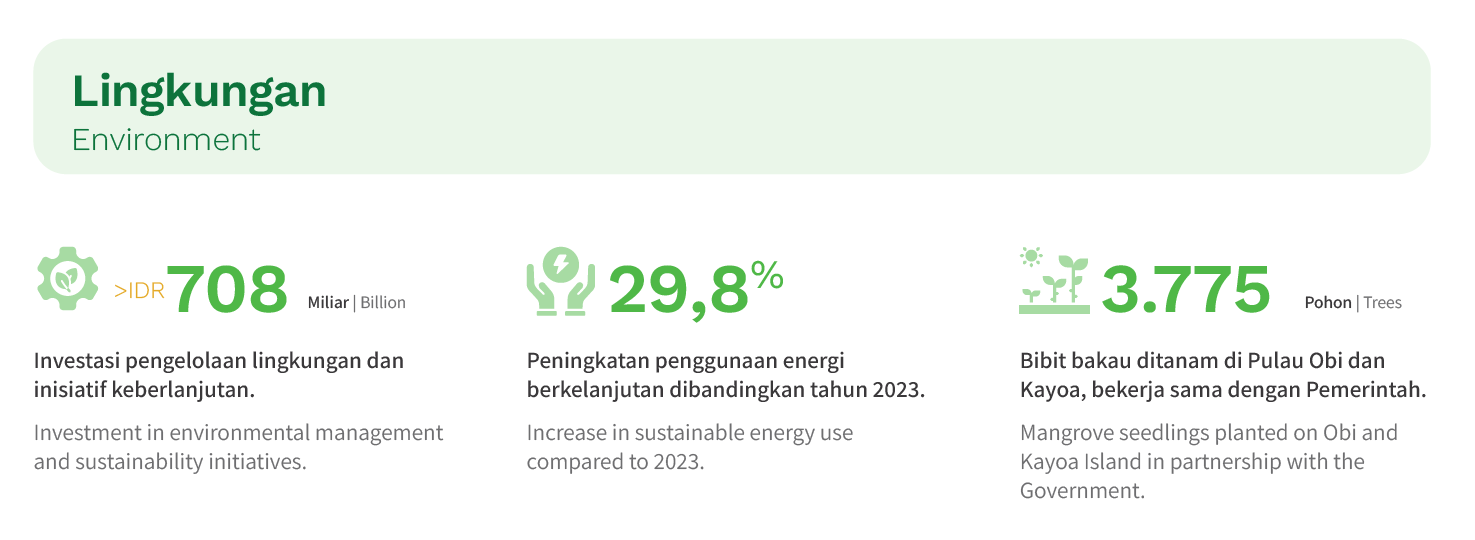
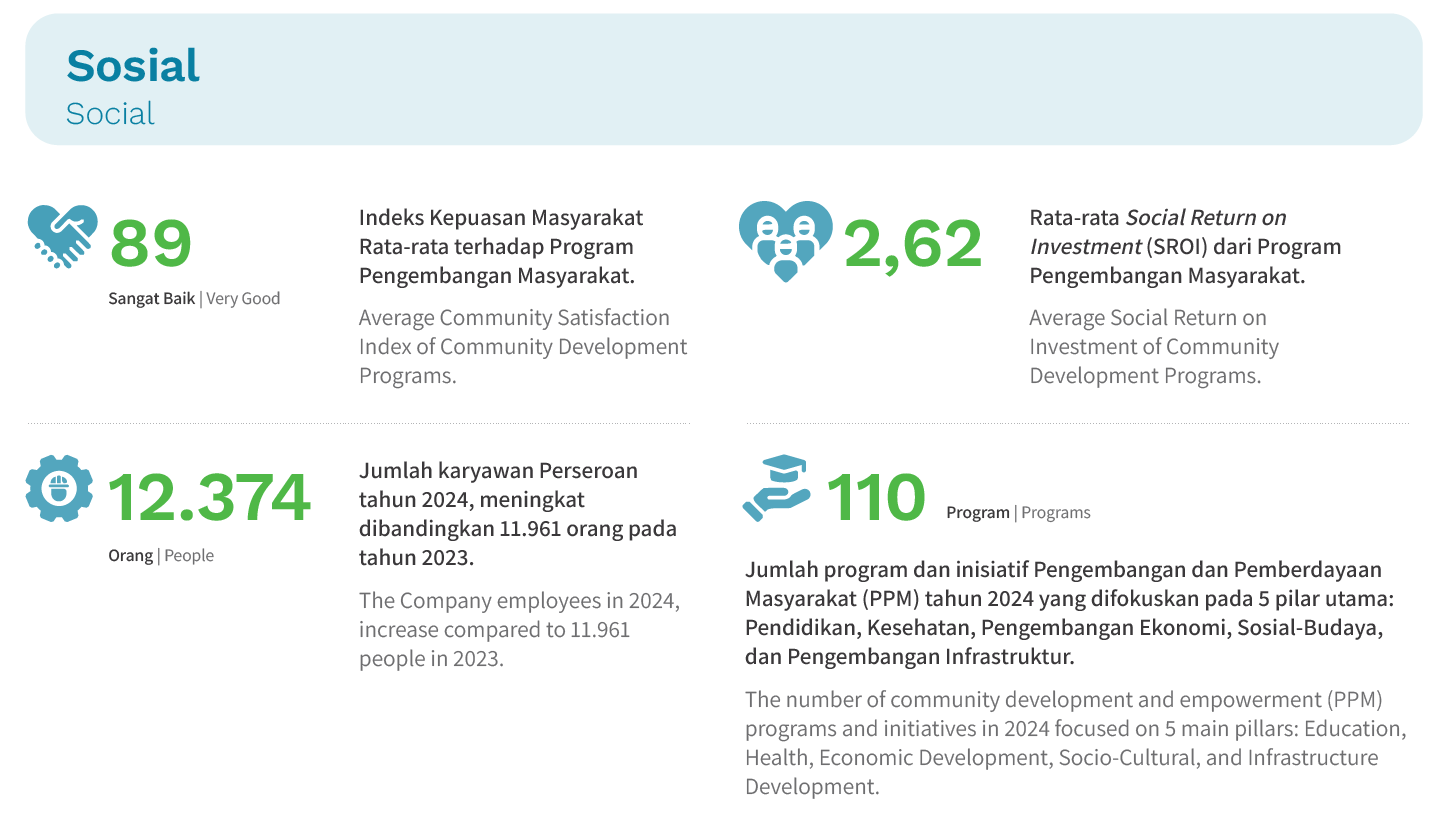
As part of its commitment to integrating sustainability principles into every aspect of its operations, the Company continues to drive transformation toward more responsible mining practices. This approach not only reflects compliance with regulations and international standards but also serves as a tangible expression of our long-term vision to create sustainable value for all stakeholders. In 2024, The Company recorded significant progress in our commitment to responsible mining by laying a solid foundation for long-term sustainability, which summarized as follows:
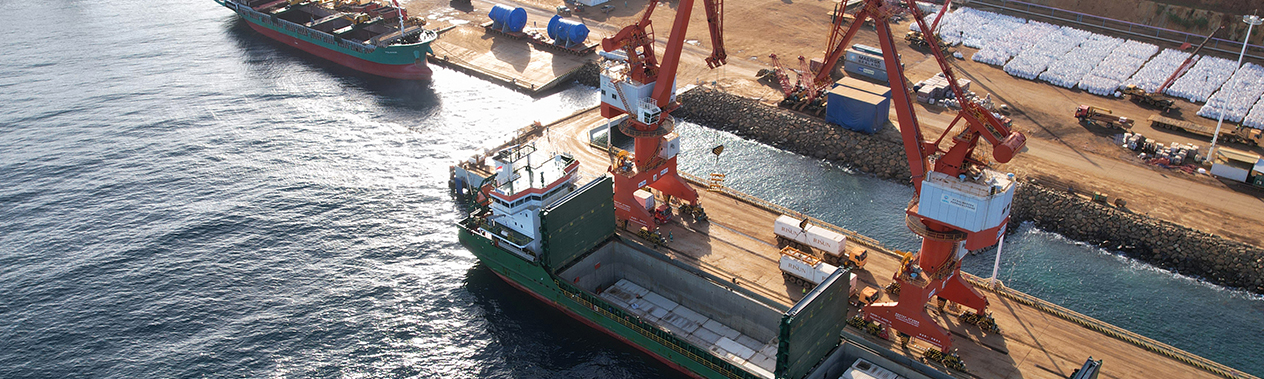
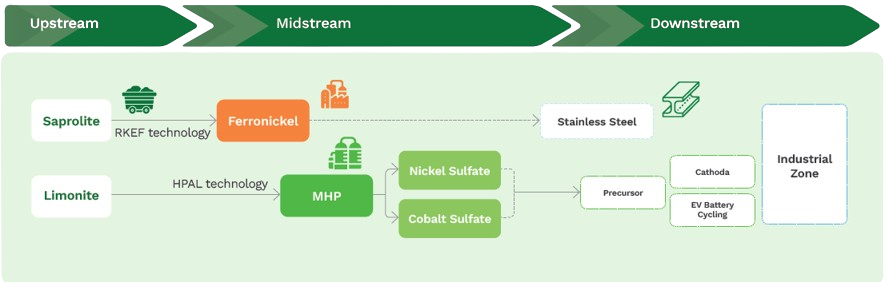
The Company is an integrated nickel producer with operations encompassing laterite nickel ore mining and downstream processing using both Rotary Kiln-Electric Furnace (RKEF) and High Pressure Acid Leaching (HPAL) technologies. All activities are centralized on Obi Island, allowing for significant logistical efficiency.
Mining Activities
Mining operations are conducted using the open-cast method, producing high-grade saprolite ore and lower-grade limonite ore. According to JORC-compliant data, the Company’s total estimated reserves and resources amount to 309.7 million wet metric tons (wmt) across four active concessions.
In 2024, nickel ore sales volume reached 23.75 million wmt, a 54.5% increase from the previous year. Saprolite sales totaled 9.16 million wmt, up by 45.5%, while limonite sales amounted to 14.59 million wmt, marking a 60.7% increase. This growth was driven by rising demand for feedstock from both RKEF smelters and HPAL facilities.
Processing Activities
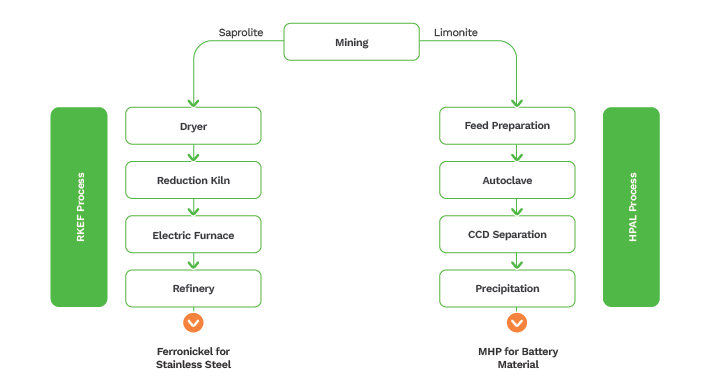
The Company operates two RKEF smelters:
-
PT MSP: 4 production lines, with an annual capacity of 25,000 tons of contained nickel in ferronickel (FeNi)
-
PT HJF: 8 production lines, with an annual capacity of 95,000 tons of contained nickel in FeNi
The combined installed capacity of these facilities stands at 120,000 tons per year. In 2024, FeNi sales volume reached 126,344 tons, representing a 25.2% increase and exceeding installed capacity.
For limonite processing, the Company operates HPAL facilities through:
-
PT HPL: 3 production lines, with a capacity of 55,000 tons of nickel-cobalt metal per year
-
PT ONC: 3 production lines, with a capacity of 65,000 tons of nickel-cobalt metal per year
The total collective capacity is 120,000 tons, including 14,250 tons of cobalt metal. In 2024, HPAL product sales (including MHP and NiSO₄) reached 102,054 tons, a 67.7% increase from the previous year.
Project Development Progress
Development of a third mining operation under PT GTS commenced in the second half of 2024, with production expected to begin in January 2025. Additionally, construction of a new smelter under PT KPS, with a planned capacity of 60,000 tons of FeNi per year, reached 94.3% completion and is targeted to commence operations in Q1 2025.
The Company also increased its ownership in PT ONC, whose second HPAL facility has been fully operational since August 2024.
Segment Profitability
The Company manages two core business segments: nickel mining and processing. The close proximity between the mining sites and processing facilities on Obi Island supports cost efficiency and competitive cash cost control. Despite global nickel price pressures, the Company has maintained profitability through operational optimization and the implementation of sound mining practices.
External Conditions Overview
The January 2024 edition of the Global Economic Prospects (GEP) report by the World Bank projected a slowdown in global economic growth, from 2.9% in 2023 to 2.4% in 2024. This moderation is attributed to tighter monetary policies, ongoing geopolitical tensions, and rising trade protectionism.
The United States economy grew by 2.8% in 2024, slightly down from 2.9% in 2023 but outperforming the earlier forecast of 2.0%. Fears of a recession did not fully materialize, as the economy experienced a soft landing.
In contrast, China’s economic growth declined from 5.4% to 5.0%, driven by weakening exports due to global conditions and several domestic challenges such as the ongoing property crisis, underperformance in the infrastructure sector, and high youth unemployment. The property crisis, which began in 2021, persisted into 2024, with several major developers facing liquidation risks. Large-scale infrastructure projects also continued to face delays.
Overall, despite being lower than the previous year, global economic growth in 2024 reached 2.6%, slightly better than the initial projection of 2.4%.
Industry Overview
Historically, the stainless steel industry accounts for about 70% of global nickel consumption, thanks to stainless steel’s high corrosion resistance, which makes it essential across sectors such as construction, automotive, home appliances, and medical equipment. Stainless steel production primarily uses ferronickel (FeNi), processed from saprolite nickel ore via the Rotary Kiln Electric Furnace (RKEF) method.
China remains the world’s largest producer of stainless steel, holding approximately 60% of the global market share, followed by Europe (12%), Indonesia (10%), India (8%), and the United States (4%). Global production in 2024 is estimated at 54–55 million tons, up from 53 million tons in 2023.
Since 2005, China has developed nickel pig iron (NPI) as a lower-cost alternative to FeNi, although it contains only 10–12% nickel. However, the prolonged property crisis and sluggish infrastructure development have slowed demand for stainless steel in China, which in turn has reduced demand for FeNi and NPI, including those exported from Indonesia.
On the other hand, nickel plays a vital role in battery manufacturing, particularly for electric vehicles (EVs). Nickel use in batteries began to rise in the 1980s and is now focused on limonite-derived products such as Mixed Hydroxide Precipitate (MHP) for EV battery applications.
Nickel demand from the battery sector has surged, accounting for 17% of global nickel consumption in 2023—up from just 3% in 2020. Meanwhile, demand from the stainless steel sector declined from 71% to 64% over the same period. The main driver is the boom in global EV sales, which reached 17.1 million units in 2024—a 25% increase from the previous year, with the fastest growth seen in China.
However, the industry is not without its challenges. The United States and the European Union imposed steep import tariffs on EVs and batteries from China—up to 100% and 45%, respectively—raising the risk of trade wars and further disrupting supply chains.
Technological competition is also intensifying between nickel-based batteries (NMC) and lithium iron phosphate (LFP) batteries. Each has distinct advantages in terms of cost, energy density, lifecycle, and safety. The rising popularity of LFP batteries could significantly shift the global demand landscape for nickel.
On the supply side, Indonesia’s nickel output has risen sharply due to rapid smelter expansion and the issuance of new mining permits (IUP). In 2024, Indonesia recorded the highest production in the world, totaling 2.2 million tons. However, this surge has led to an oversupply and subsequent decline in global nickel prices.
According to the World Bank’s Commodity Markets Outlook (October 2024), the average LME nickel price stood at US$16,814 per ton—down 21.9% from 2023. After peaking at US$19,587 in May, prices steadily declined to US$15,445 by December 2024, marking a 4.1% annual drop.