Annual Report 2023
Annual Report 2023
Leading the Transition to Sustainable Value Chains
In 2023, the global commodities market continued to correct itself after experiencing a commodity supercycle, primarily due to geopolitical conflicts in Europe. The trend of nickel prices reversed direction due to decreased demand and increased supply growth. However, the Company mitigated these dynamics by consistently prioritizing operational excellence through the implementation of good mining practices, focusing on strengthening a safety-first culture and maintaining cost leadership to achieve effective and efficient production levels.
The completion of several expansion projects by the subsidiaries resulted in a significant increase in production capacity and drove revenue growth. The Company’s strategy is to maintain production and sales at the most optimal level to ensure positive profitability and sound financial performance. Amidst challenges in the global market, the Company is focused on realizing the downstream integration of the nickel industry as a milestone achievement in the development of Indonesia’s new energy resources sector. In anticipation of market improvements, the Company is poised to lead the transition towards a sustainable value chain.
Governance
We have strengthened our sustainability governance by introducing several key policies designed to embed sustainability across the entire organization. Notably, the launch of our consolidated Sustainability Policy marked a major milestone—demonstrating a strategic commitment to placing sustainability at the heart of our operations.
New policies on responsible raw material procurement and land acquisition were also introduced, along with the development of a Human Rights Policy. These policies are more than just guiding documents—they reflect our Group’s dedication to leading the industry in responsible mining and processing.
The Company remains responsive to evolving industry standards and stakeholder expectations. As part of this commitment, we are advancing assessments against two globally recognized frameworks:
-
The Initiative for Responsible Mining Assurance (IRMA), which will evaluate all mining sites under the Company’s responsibility, with full completion expected by 2025.
-
The Responsible Minerals Assurance Process (RMAP) under the Responsible Minerals Initiative (RMI), which aims to certify responsible sourcing practices at PT HPL, targeting conformance by 2024.
Environment
Greenhouse gas (GHG) emission reduction remains a top priority both in Indonesia and globally. In 2023, we partnered with an international development agency to explore tailored decarbonization scenarios suitable for our remote operations on Obi Island.
We also conducted internal assessments to better understand climate risks and the life cycle costs associated with our operations. This approach supports a phased investment strategy for decarbonization—one that balances investor interests with the long-term sustainability of our business.
In 2023, we initiated planning for a 300 MWp solar power plant, which is scheduled to begin operation in 2025. Development is actively underway at the time of this report.
In support of biodiversity protection, the Company has committed to achieving a net terrestrial conservation gain within 20 years. To help realize this vision, we launched a landscape-level Nature Risk Assessment across Obi Island to better understand the broader ecological impact of our mining activities.
Our long-term conservation ambitions extend beyond our operational boundaries. We continue to restore and revegetate mined land, with 232.09 hectares revegetated as of the end of 2023. We are also protecting coastal zones through mangrove forest rehabilitation, and on the marine conservation front, nearly 1,700 artificial reef blocks have been installed to stimulate coral growth and support fish spawning grounds.
Additionally, we expanded our sedimentation ponds in 2023, increasing capacity to the equivalent of more than 500 Olympic-sized swimming pools, ensuring effective runoff water management at our operational sites.
Social
In 2023, we conducted a Human Rights Due Diligence Assessment with the support of the Foundation for International Human Rights Reporting Standards (FIHRRST). Aligned with the UN Guiding Principles on Business and Human Rights, this assessment will help us proactively address growing expectations around human rights protections across the mineral supply chain.
It also enhances our ability to understand, support, and engage with communities around Obi Island. Our community support efforts continued throughout 2023, delivering a Social Return on Investment (SROI) of 2.81. Our SME development programs showed strong progress, with significant increases in total income.
In the same year, we launched Salam Kawasi, an integrated agricultural center, and completed the construction of a new settlement for Desa Kawasi, aligned with government-led resettlement initiatives.
The human rights assessment also informed our initiatives in Operations, Health, and Safety. We are proud to have achieved certifications in ISO 14001 (Environmental Management), ISO 45001 (Occupational Health & Safety), and SMK3 (Indonesian Occupational Safety Management System) across several business units, with further certifications planned in 2024.
On the labor front, we reaffirmed our commitment to diversity and inclusion by establishing a Gender and Diversity Task Force.
As of 2023, 85% of our total workforce were Indonesian nationals, with 46% originating from North Maluku. We also increased the number of local suppliers to 164, up from just 35 in 2020. Notably, North Maluku recorded the highest economic growth among all 38 Indonesian provinces in 2023.
Environment
Greenhouse gas (GHG) emission reduction remains a top priority both in Indonesia and globally. In 2023, we partnered with an international development agency to explore tailored decarbonization scenarios suitable for our remote operations on Obi Island.
We also conducted internal assessments to better understand climate risks and the life cycle costs associated with our operations. This approach supports a phased investment strategy for decarbonization—one that balances investor interests with the long-term sustainability of our business.
In 2023, we initiated planning for a 300 MWp solar power plant, which is scheduled to begin operation in 2025. Development is actively underway at the time of this report.
In support of biodiversity protection, the Company has committed to achieving a net terrestrial conservation gain within 20 years. To help realize this vision, we launched a landscape-level Nature Risk Assessment across Obi Island to better understand the broader ecological impact of our mining activities.
Our long-term conservation ambitions extend beyond our operational boundaries. We continue to restore and revegetate mined land, with 232.09 hectares revegetated as of the end of 2023. We are also protecting coastal zones through mangrove forest rehabilitation, and on the marine conservation front, nearly 1,700 artificial reef blocks have been installed to stimulate coral growth and support fish spawning grounds.
Additionally, we expanded our sedimentation ponds in 2023, increasing capacity to the equivalent of more than 500 Olympic-sized swimming pools, ensuring effective runoff water management at our operational sites.
Social
In 2023, we conducted a Human Rights Due Diligence Assessment with the support of the Foundation for International Human Rights Reporting Standards (FIHRRST). Aligned with the UN Guiding Principles on Business and Human Rights, this assessment will help us proactively address growing expectations around human rights protections across the mineral supply chain.
It also enhances our ability to understand, support, and engage with communities around Obi Island. Our community support efforts continued throughout 2023, delivering a Social Return on Investment (SROI) of 2.81. Our SME development programs showed strong progress, with significant increases in total income.
In the same year, we launched Salam Kawasi, an integrated agricultural center, and completed the construction of a new settlement for Desa Kawasi, aligned with government-led resettlement initiatives.
The human rights assessment also informed our initiatives in Operations, Health, and Safety. We are proud to have achieved certifications in ISO 14001 (Environmental Management), ISO 45001 (Occupational Health & Safety), and SMK3 (Indonesian Occupational Safety Management System) across several business units, with further certifications planned in 2024.
On the labor front, we reaffirmed our commitment to diversity and inclusion by establishing a Gender and Diversity Task Force.
As of 2023, 85% of our total workforce were Indonesian nationals, with 46% originating from North Maluku. We also increased the number of local suppliers to 164, up from just 35 in 2020. Notably, North Maluku recorded the highest economic growth among all 38 Indonesian provinces in 2023.
Review of External Conditions
In 2023, the global economy faced significant challenges due to slowing growth in advanced economies, the prolonged impact of the Russia-Ukraine war, and monetary policy uncertainties. In China, although the economy began to recover following the relaxation of the Zero-COVID policy, the property sector crisis remained a major drag. Geopolitical tensions and declining prices of key commodities also weighed on global trade, including Indonesia. Domestically, investors tended to adopt a wait-and-see stance in the run-up to the 2024 General Election.
Nevertheless, Indonesia demonstrated resilience with economic growth of 5.05%. The downstreaming program, supported by various government policies, helped mitigate the slowdown in investment during the political year. Downstream investments in the mineral sector, such as nickel, bauxite, and copper smelters, as well as electric vehicle battery plants, continued to progress and served as a key driver of investment growth.
Industry Review
Indonesia holds the world’s largest nickel reserves, making it a key player in the global industry. Historically, nickel demand has been dominated by the stainless steel sector, but the energy transition is driving increased demand for electric vehicle batteries. In 2022, the nickel industry experienced a positive trend, with prices strengthening significantly due to rising global demand and geopolitical factors. However, in 2023, the nickel market came under pressure from the global economic slowdown, geopolitical tensions, and oversupply, particularly from Indonesia and China. Nickel prices fell sharply compared to the previous year. Even so, Indonesia continues to push downstreaming to enhance the added value of its domestic nickel industry.
Business Segment Review
The Company plays a role in Indonesia’s nickel downstreaming through the development of RKEF plants for ferronickel production and the establishment of Indonesia’s first HPAL plant to supply raw materials for electric vehicle batteries. Its main operations include nickel ore mining and industrial estate management on Obi Island, North Maluku. The Company has reserves of approximately 301.9 million WMT across four mining concessions (PT TBP, PT GPS, PT JMP, and PT GTS). In 2023, the Company established a joint venture, PT KTS, in which it holds a 36% stake, to support business expansion.
The World Bank projects nickel prices to decline by 10% in 2024 due to increased supply from China, Indonesia, and the Philippines. However, demand for electric vehicle batteries is expected to rise in 2025. To address these challenges, the Company is focusing on operational efficiency and cost leadership, while expanding its market presence through strategic partnerships with China.
The Company is also continuing its expansion with the construction of ferronickel plants under PT KPS and PT OSS, as well as HPAL production through PT ONC, which is targeted to commence operations in April 2024. With a capacity 125% greater than PT HPL, this facility will be the largest in Indonesia. To meet raw material requirements, the Company will develop the mines under PT GPS and PT JMP.
The Board of Directors effectively managed the Company evidenced by the operational and financial performance achievements for the 2023 financial year. However, we must not be complacent and decelerate our readiness to respond to all possible changes that will occur. Challenges facing the nickel industry will persist and grow more complex.
Donald J Hermanus
Board of Commissioners
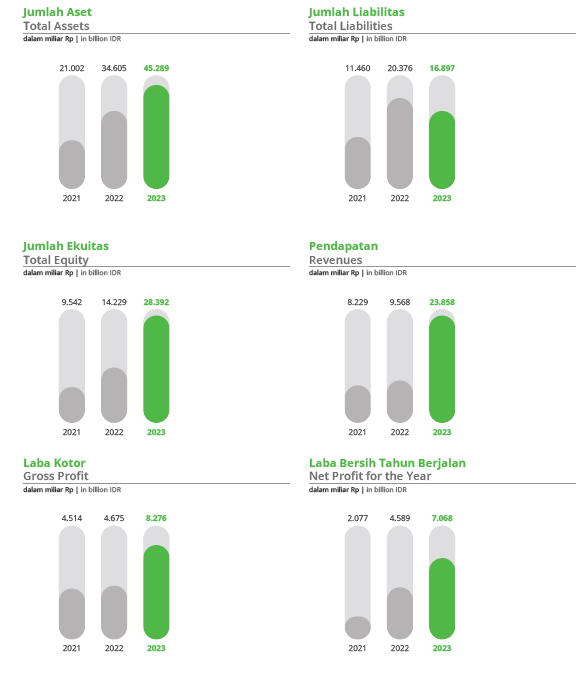
The completion of several production capacity expansion projects by subsidiaries and associates on schedule has driven a significant increase in production and sales volume so that the Company managed to maintain growth performance with good profitability amidst the challenges of nickel prices in the global market in 2023.
Roy A Arfandy
Board of Directors